PRP Hair Loss — regenerative scalp treatment
We use your own blood to stimulate the hair follicles in your scalp.
This is not an aesthetic treatment. We assign a clinical diagnosis, document the scalp with before and after photos, and follow up the result in your medical record.
Medically reviewed by Johan Hedevåg, MD
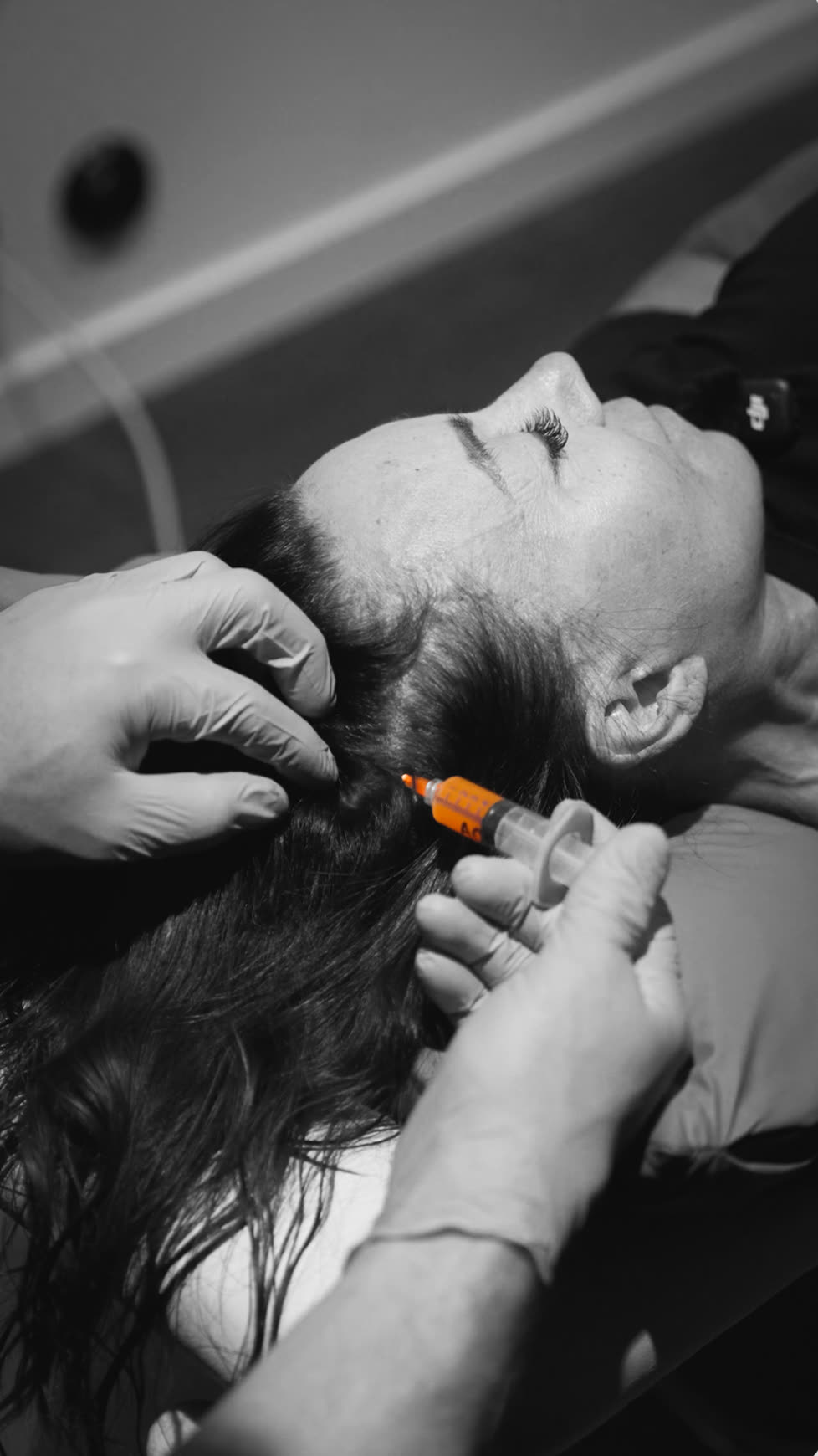
PRP for hair loss is a regenerative treatment where concentrated platelets from your own blood are injected intradermally into the scalp to stimulate the follicles and slow the progression of hair loss. The programme comprises four treatments with clinical diagnosis, photo documentation and follow-up.
How it works
- 01Medical form and photosBefore your visitAfter booking you receive a medical form in HLTHY where you describe your hair loss and medical history and upload photos of your scalp. Your answers go straight into your medical record and give us a baseline before your first visit.
- 02Assessment and diagnosisVisit 1At your first visit we review your history, examine the scalp and assign a clinical diagnosis. We assess whether the treatment is suitable for you and whether further blood tests are needed.
- 03Treatment 1Week 0We draw a blood sample and centrifuge it to isolate your platelet-rich plasma. About 5–6 ml is injected intradermally into the scalp, distributed across roughly 60–100 injections over the area being treated.
- 04Treatment 2Week 4The same procedure is repeated four weeks after the first treatment to maintain stimulation of the follicles.
- 05Treatment 3Week 8The third treatment is given about four weeks after the second. We take new photos so the change can be tracked objectively.
- 06Follow-up and treatment 4Month 5–6At 5–6 months we follow up the result and compare it with your baseline photos. The fourth treatment is given at the follow-up when it is clinically indicated.
Patients on the treatment
Two of our patients describe their experience of the treatment programme — in their own words, filmed at the clinic.
Carina
Carina's advice for anyone considering PRP for hair loss.
Åsa
Åsa shares her hair loss journey and thoughts before treatment.
Pricing and what's included
The treatment programme is the first choice — the effect builds on repeated treatments. A single treatment is available if you prefer to start smaller.
Four treatments at weeks 0, 4 and 8 and at the follow-up after 5–6 months.
- Medical form and photo documentation in your record
- Clinical assessment and diagnosis
- Four PRP scalp treatments
- Follow-up after 5–6 months with photo comparison
One PRP scalp treatment, including assessment and photo documentation.
For patients who have completed the treatment programme. Booked through your clinic at follow-up.
The treatment is performed by licensed healthcare professionals at our clinics in Stockholm City and Västerås.
Recovery over time
Why we treat hair loss medically
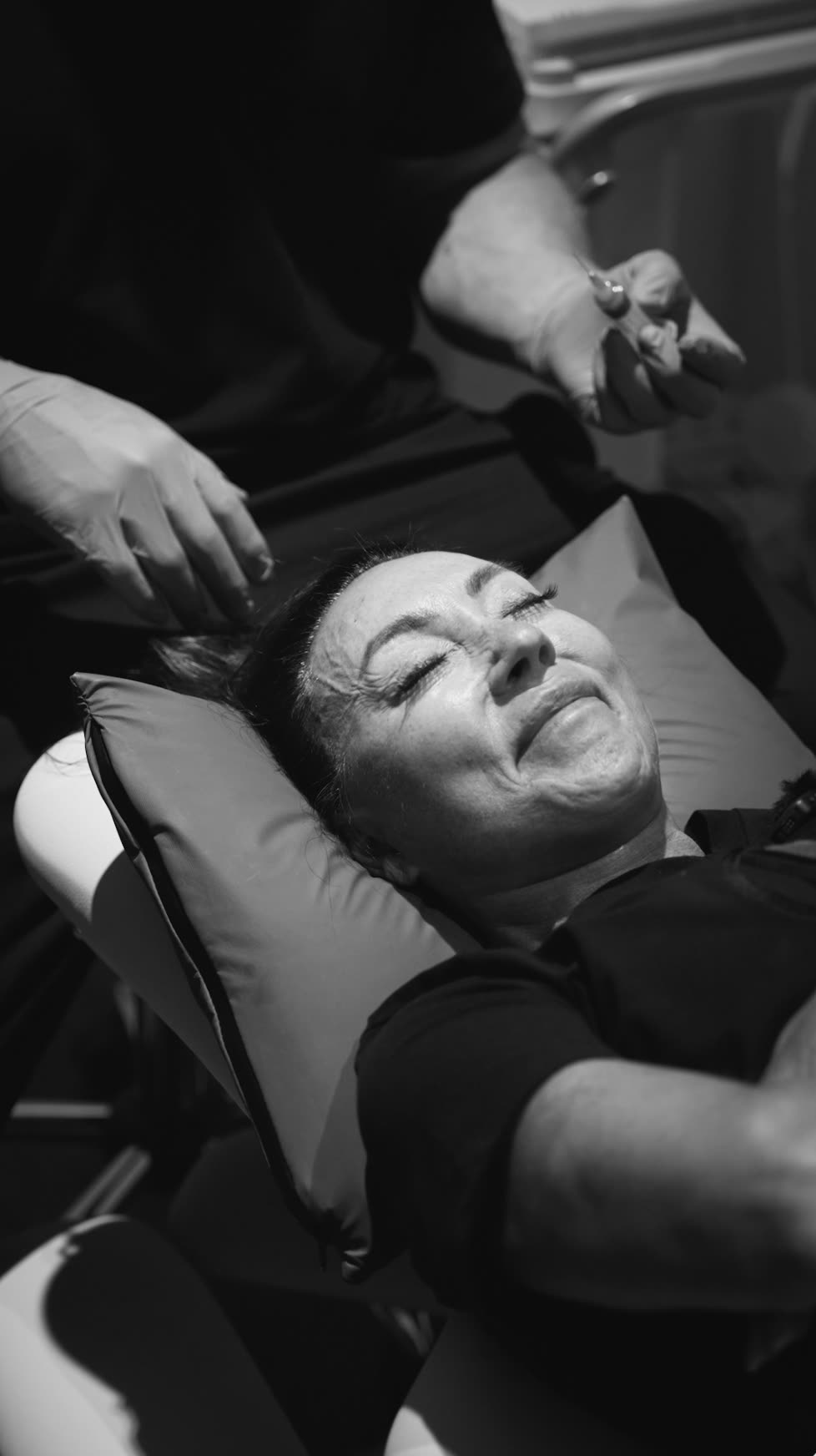
Hair loss is in most cases a progressive condition. Follicles miniaturise gradually before they stop producing hair, and that process cannot be reversed once a follicle is lost. The goal of treatment is therefore to slow progression and strengthen the follicles that are still active — not to create new hair where follicles are gone.
We treat hair loss as a medical condition, not as a cosmetic procedure. That means we take your history, examine the scalp, assign a clinical diagnosis and document your baseline with photos. Everything is recorded in your medical record, and at follow-up we compare against those same images — so the decision to continue or stop is based on actual change.
The earlier treatment begins, the more there is to preserve. Treatment can be combined with medical therapy and evaluation of underlying factors such as iron, thyroid and hormonal status.
A progressive process — the goal is to slow it, not to create new hair
Clinical diagnosis and photo documentation in your medical record
The earlier treatment begins, the more there is to preserve
What does the research say?
Findings from peer-reviewed publications.
Systematic review (2023): PRP produced significantly increased hair density and thickness in androgenetic alopecia compared with placebo, with a good safety profile.
Meta-analysis: PRP injections into the scalp significantly increased hair density compared with control treatment in androgenetic alopecia.
Network meta-analysis (2022) of treatments for androgenetic alopecia: PRP ranked among the most effective options for increasing hair density.
Randomised trial (2021): repeated PRP treatments improved hair density compared with control, with the effect depending on the number of treatments.
When this treatment isn't right
- Active infection or inflammation of the scalp
- Blood disorders or platelet dysfunction
- Ongoing treatment with blood thinners that cannot be paused
- Active cancer or ongoing cancer treatment
- Pregnancy and breastfeeding
- Areas where follicles are entirely lost — there is nothing left to stimulate
Questions about PRP Hair Loss
Frequently asked questions
Read more
Ready to slow your hair loss?
After booking you receive a medical form where you describe your hair loss and upload photos of your scalp. At your first visit we assign a diagnosis and start the treatment.
Related articles
Go deeper into the evidence behind our treatments.
Knee or hip osteoarthritis? Alternatives to surgery
Explore non-surgical treatments for osteoarthritis — PRP, orthobiologic treatment and rehabilitation. Avoid knee or hip surgery with regenerative medicine.
Read articleRegenerative treatment for osteoarthritis
Regenerative treatment options for osteoarthritis — what is orthobiologic treatment, what does the research say, and who is it for?
Read articlePRP treatment for tendons and joints — how it works
Learn how PRP (platelet rich plasma) treats osteoarthritis, tendon injuries and joint problems using your body's own growth factors. Evidence, process and results.
Read article